Manufacturing companies are no longer dependent only on trade shows, distributors, referrals, and traditional sales teams to generate business. Today, industrial buyers use Google, AI search engines, online directories, social media, and company websites to research suppliers before requesting a quote.
A strong digital marketing strategy for the manufacturing industry helps companies increase online visibility, attract qualified B2B buyers, generate leads, and build long-term authority.
What Is Digital Marketing for Manufacturing Companies?
Digital marketing for manufacturers is the use of online channels to promote products, services, capabilities, and expertise to potential customers.
A successful strategy can include:
- Search engine optimization (SEO)
- Content marketing
- Pay Per Click Advertising
- Social Media Marketing
- Email marketing
- Online reputation management
- Website optimization
- Web Development Services
- E-Commerce Marketing Services
- Analytics and conversion tracking
- Web Founders USA
The goal is not simply to generate website traffic. The objective is to attract qualified decision-makers, convert them into leads, and support the sales process.
Key Digital Marketing Channels for Manufacturers
|
Digital Channel |
Primary Purpose |
Manufacturing Benefit |
|
SEO |
Increase organic visibility | Reach buyers searching for products and suppliers |
| Content Marketing | Educate prospects |
Demonstrate technical expertise |
|
PPC |
Generate immediate traffic | Capture high-intent searches |
| Social Media | Build brand awareness |
Connect with B2B decision-makers |
|
Website |
Convert visitors | Generate quote and inquiry requests |
| Email Marketing | Nurture leads |
Stay connected with prospects |
|
E-Commerce |
Sell products online | Simplify purchasing and repeat orders |
Analytics |
Measure performance |
Improve marketing ROI |
1. Build an SEO-Friendly Manufacturing Website
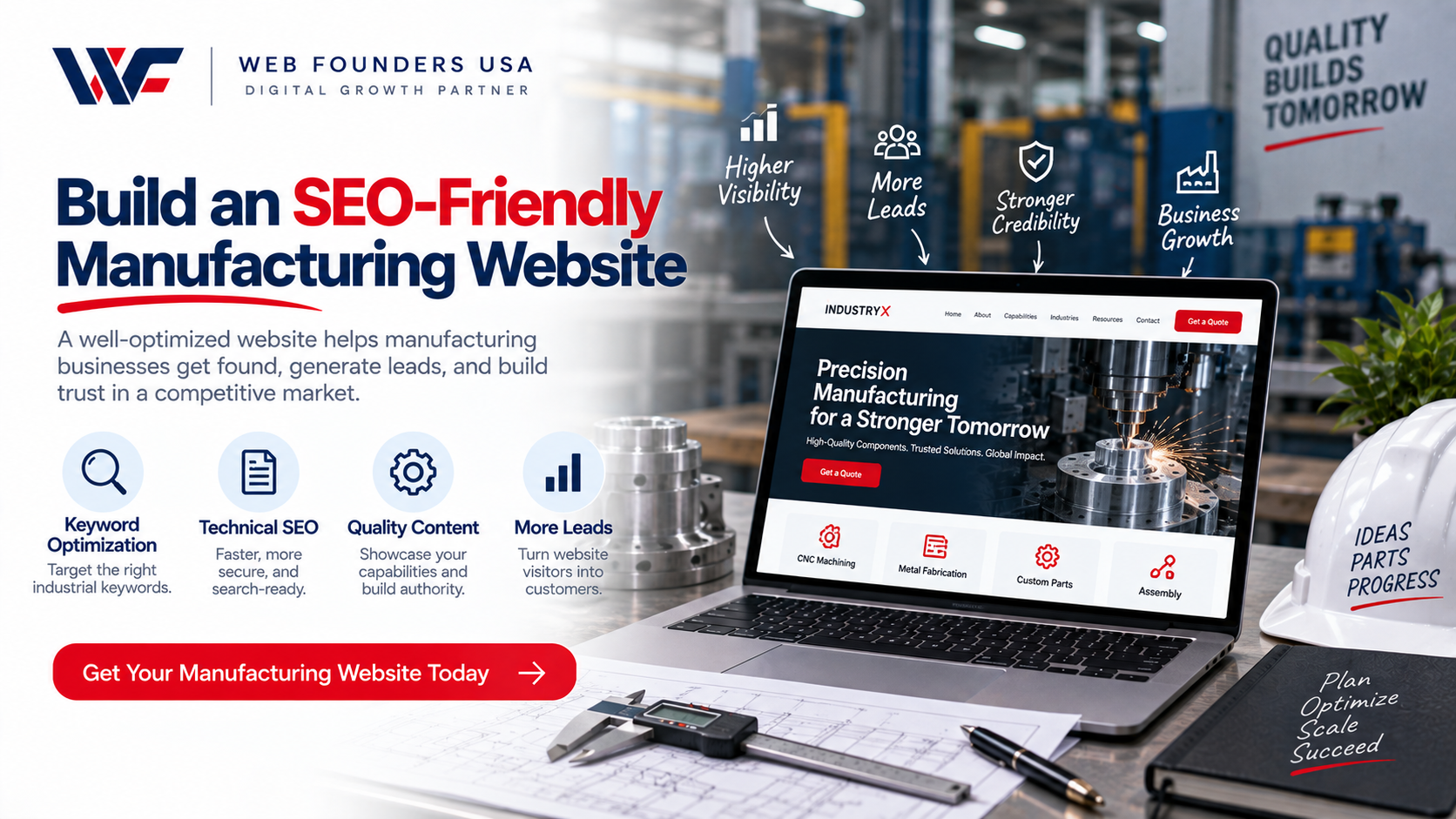
Your website is the foundation of your online marketing strategy. Industrial buyers expect websites to provide accurate product information, technical specifications, certifications, applications, and contact options.
Professional Web Development Services can help manufacturers create websites that are:
- Mobile-friendly
- Fast-loading
- Secure
- Easy to navigate
- Search-engine optimized
- Designed for lead generation
- Structured for AI and answer-engine visibility
Important website pages may include:
- Product and service pages
- Industries served
-
Manufacturing capabilities
-
Case studies
- Certifications
- Technical resources
- FAQs
- Contact and quote-request pages
Every important page should have a clear purpose and call to action.
How Manufacturing Companies Can Generate Better Leads Online
Not every website visitor is a potential customer. A successful manufacturing marketing strategy focuses on attracting the right audience.
Manufacturers should define their ideal customers based on:
- Industry and application
- Geographic market
- Company size
- Purchasing requirements
- Product specifications
- Order volume
- Budget
- Decision-making role
For example, a manufacturer supplying automotive components should create dedicated content for automotive procurement teams rather than relying on generic industrial messaging.
Lead Generation Funnel for Manufacturers
|
Funnel Stage |
Buyer Intent |
Recommended Marketing |
|
Awareness |
Learning about a problem |
Blog posts, educational videos, SEO |
|
Research |
Comparing solutions | Product guides, comparison pages |
|
Consideration |
Evaluating suppliers |
Case studies, certifications, testimonials |
|
Purchase |
Ready to contact a supplier |
Quote forms, calls, product pages |
| Retention | Existing customer |
Email marketing, product updates |
This approach ensures that your digital marketing supports buyers throughout the entire customer journey.
Create Location-Based Manufacturing Content
For manufacturers serving specific regions, local SEO and GEO targeting can be valuable.
Create dedicated location and service pages when you genuinely serve those markets. For example:
- Industrial manufacturing services in Texas
- CNC machining services in California
- Custom fabrication services in Ontario
- Industrial equipment suppliers in Chicago
However, location pages should provide genuine value rather than simply repeating city names. Include relevant capabilities, industries served, service areas, facilities, delivery information, and customer requirements.
This can help search engines and AI systems understand where your company operates and what it provides.
Build Topic Authority With Content Clusters
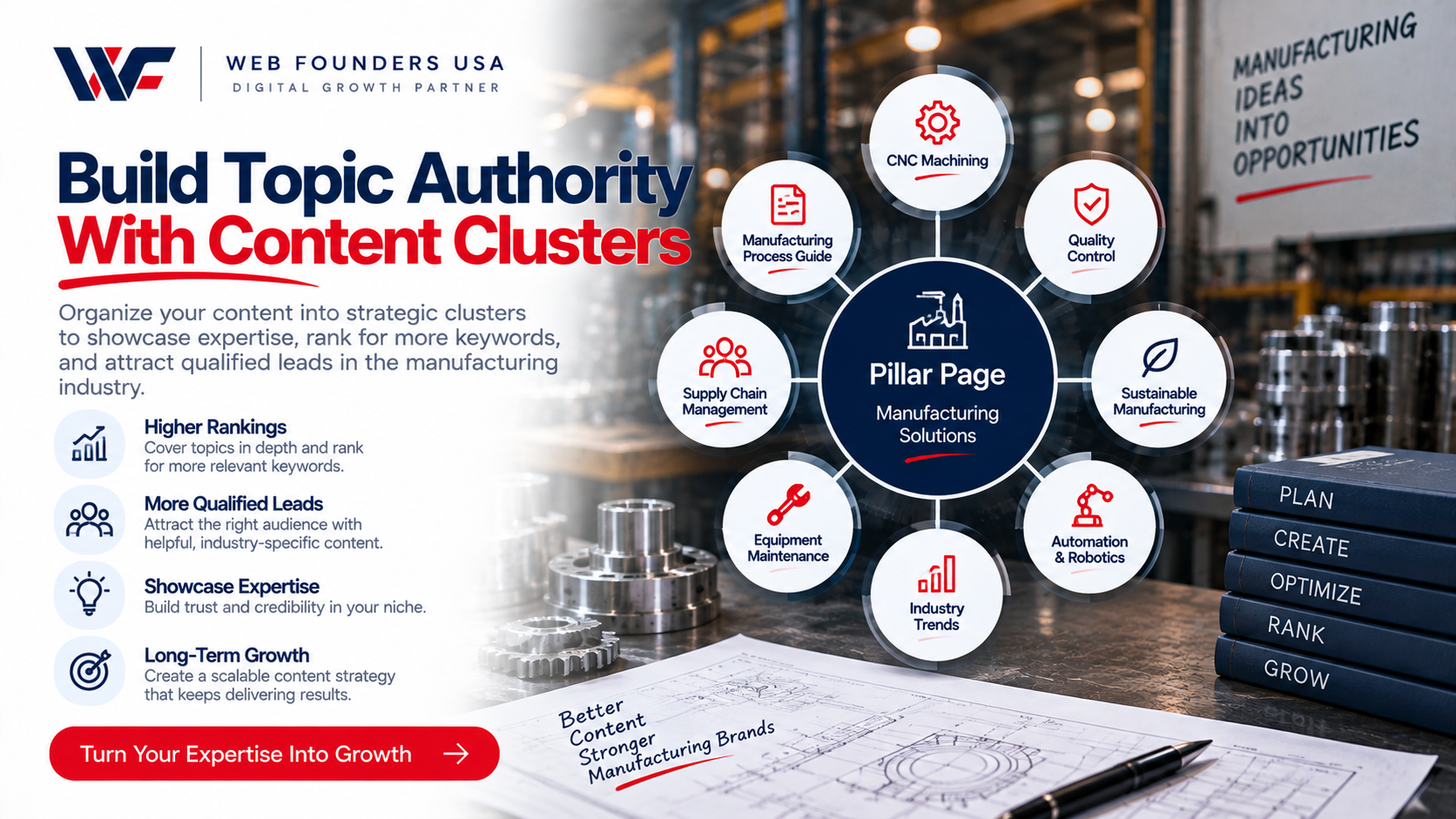
Instead of publishing unrelated blog posts, manufacturers can organise content into topic clusters.
For example, a CNC machining company could build a central CNC Machining Services page supported by related articles:
- What Is CNC Machining?
- CNC Milling vs. CNC Turning
- CNC Machining Materials
- CNC Machining Tolerances
- How Much Does CNC Machining Cost?
- CNC Machining for Aerospace Components
- CNC Machining for Automotive Parts
Each article should provide useful information and naturally connect to relevant service or product pages.
This structure helps users navigate the website while strengthening topical relevance for search engines.
Use Data to Improve Your Marketing Strategy
A manufacturing marketing campaign should be continuously tested and improved.
Important KPIs
|
KPI |
Why It Matters |
|
Organic Traffic |
Measures SEO visibility |
|
Qualified Leads |
Shows lead quality |
|
Quote Requests |
Indicates purchase intent |
|
Conversion Rate |
Measures website effectiveness |
|
Cost Per Lead |
Evaluates acquisition efficiency |
|
Keyword Rankings |
Tracks search visibility |
|
Engagement |
Shows content relevance |
|
Revenue |
Measures business impact |
Do not judge a campaign solely by traffic. A smaller number of highly qualified visitors can be more valuable than thousands of irrelevant visitors.
Strengthen Trust With Manufacturing Proof
Manufacturing buyers want evidence before choosing a supplier. Your website should make that evidence easy to find.
Include:
- Industry certifications
- Quality standards
- Production capabilities
- Equipment information
- Years of experience
- Case studies
- Customer testimonials
- Product specifications
- Warranty information
- Quality-control processes
- Facility photographs
These elements support both traditional SEO and GEO optimization by providing clear signals about the company’s expertise and capabilities.
Optimize Product and Service Pages for AEO
AEO-friendly pages should answer important questions quickly.
For example:
What manufacturing services do you provide?
A manufacturer might provide CNC machining, injection molding, metal fabrication, assembly, prototyping, or other specialized production services depending on its capabilities.
What industries do you serve?
Clearly list the industries you actually serve, such as automotive, aerospace, medical, construction, electronics, energy, or industrial equipment.
How can customers request a quote?
Provide a visible quote button and explain what information customers should submit, such as drawings, specifications, quantities, materials, and required delivery dates.
Short, direct answers make pages easier for both customers and answer engines to understand.
Integrate Digital Marketing With Sales
Marketing and sales should work together. When someone submits a quote request, the sales team should have enough information to understand the lead.
A strong system can capture:
- Company name
- Contact information
- Product or service required
- Quantity
- Industry
- Project timeline
- Technical requirements
- Uploaded drawings or documents
Marketing teams can then analyze which campaigns and keywords produce the highest-quality opportunities.
The Future of Manufacturing Digital Marketing
Manufacturing buyers will continue to use search engines, online platforms, and AI-powered tools to research suppliers. Companies that provide clear, accurate, and useful information will be better positioned to capture this demand.
A future-ready strategy should combine:
- Technical SEO for search visibility.
- AEO for direct-answer searches.
- GEO for AI-generated search experiences.
- Content marketing for education and authority.
- PPC for high-intent traffic.
- Social Media Marketing for brand awareness.
- Web Development Services for performance and conversions.
- E-Commerce Marketing Services for online product sales.
- Analytics for continuous improvement.
